AI in US Education 2026: Tools & Trends

Anúncios
The integration of AI in US Education has moved beyond the experimental phase and into a transformative reality.
As we navigate the 2025–2026 academic year, the focus has shifted from “if” we should use these tools to “how” we can use them to bridge the equity gap and personalize learning at scale.
Artificial intelligence is no longer just a digital assistant; it is becoming the backbone of a more responsive, data-informed classroom.
Anúncios
From reducing teacher burnout to providing 24/7 personalized tutoring for every student, the potential to reshape the American educational landscape is unprecedented.
The Accelerating Integration of AI in US Education
The landscape of education is undergoing a significant transformation, with artificial intelligence emerging as a powerful catalyst for change.
School districts nationwide are exploring AI’s potential to enhance personalized learning, streamline administrative tasks, and provide data-driven insights.
Anúncios
This integration is not merely theoretical; it’s manifesting in tangible tools designed to support both teachers and students.
The focus is on practical, accessible solutions that can be seamlessly woven into existing curricula and pedagogical approaches.
By Spring 2026, many K-12 teachers are expected to be leveraging these AI advancements, marking a pivotal moment in the modernization of US educational practices. The rapid adoption underscores a commitment to innovation and student success.
Understanding the Impact of AI in US Education on Teaching Practices
Artificial intelligence is poised to redefine traditional teaching methodologies, moving beyond rote memorization to foster critical thinking and creativity.
Teachers are finding AI particularly useful for differentiating instruction, catering to the diverse needs of learners in a single classroom.
The shift also involves a re-evaluation of teacher roles, with AI handling repetitive tasks, allowing educators to focus more on mentorship and individualized student support.
This reallocation of time is critical for addressing complex student challenges and fostering deeper engagement.
Ultimately, the impact of AI in US Education is about empowering teachers with advanced capabilities, enabling them to create more dynamic, responsive, and effective learning environments for every student. This transformative power is undeniable.
Personalized Learning Pathways with AI
AI-powered adaptive learning platforms are at the forefront of personalized education. These tools analyze student performance, identify knowledge gaps, and then tailor content and pace to each individual’s needs, optimizing their learning journey.
For K-12 teachers, this means less time spent on manual differentiation and more time on targeted interventions and enrichment activities.
Students receive instruction that is precisely aligned with their current understanding, fostering greater mastery and confidence.
- Individualized content delivery based on real-time progress.
- Dynamic adjustments to learning pace and difficulty.
- Targeted remediation for specific skill deficits.
- Enrichment opportunities for advanced learners.
Automated Assessment and Feedback Systems
Grading and providing constructive feedback can be time-consuming for teachers. AI-driven assessment tools automate this process, offering immediate and detailed insights to students and educators alike.
These systems can evaluate a range of assignments, from multiple-choice quizzes to essays, providing objective feedback that helps students understand their mistakes and improve.
This frees up teacher time for more qualitative feedback and one-on-one interactions.
- Instantaneous grading for various assignment types.
- Detailed, actionable feedback for student improvement.
- Identification of common misconceptions across a class.
- Reduced teacher workload for administrative tasks.
Tool 1: Adaptive Learning Platforms for Individualized Instruction
Adaptive learning platforms are perhaps one of the most direct applications of AI in US Education.
These platforms leverage machine learning algorithms to assess student proficiency and adapt the curriculum accordingly, creating a truly personalized learning experience.
By Spring 2026, many K-12 classrooms will see these platforms as indispensable, providing teachers with granular data on student progress and areas needing improvement.
This data allows for highly targeted interventions and support.
Examples include platforms that adjust problem difficulty in math, recommend reading materials based on comprehension levels, or offer alternative explanations for complex science concepts. This tailored approach ensures every student is challenged appropriately.

Key Features and Benefits for K-12 Teachers
These platforms offer robust analytics dashboards, giving teachers a comprehensive view of individual and class performance. This data is invaluable for informing instructional decisions and communicating with parents.
The ability to automatically differentiate content means teachers can spend less time creating varied lesson plans and more time engaging with students. It also helps manage classrooms with diverse learning needs more effectively.
- Real-time student performance tracking.
- Automated content adjustment based on learning pace.
- Reduced planning time for differentiated instruction.
- Enhanced student engagement through tailored challenges.
Tool 2: AI-Powered Tutoring and Support Systems
AI-powered tutoring systems are emerging as crucial complements to traditional teaching, offering students on-demand assistance and reinforcing classroom learning.
These systems can provide explanations, practice problems, and step-by-step guidance, much like a human tutor.
For K-12 teachers, these tools extend their reach beyond the classroom, providing continuous support for students struggling with concepts or needing extra practice. This ensures that learning doesn’t stop when the school bell rings.
The availability of such personalized support can significantly reduce achievement gaps and boost student confidence, making complex subjects more accessible. This is a vital aspect of the expanding role of AI in US Education.
How AI Tutors Enhance Learning Outcomes
AI tutors are designed to understand student queries and provide clear, concise responses, often using natural language processing. They can identify common errors and offer targeted exercises for improvement.
This immediate feedback loop is critical for learning, preventing students from reinforcing incorrect understandings. The consistent availability of an AI tutor ensures help is always at hand, fostering independent learning habits.
- 24/7 access to academic support.
- Personalized explanations and practice problems.
- Immediate feedback on student responses.
- Reduction in student frustration with challenging topics.
Tool 3: AI for Content Generation and Curriculum Design
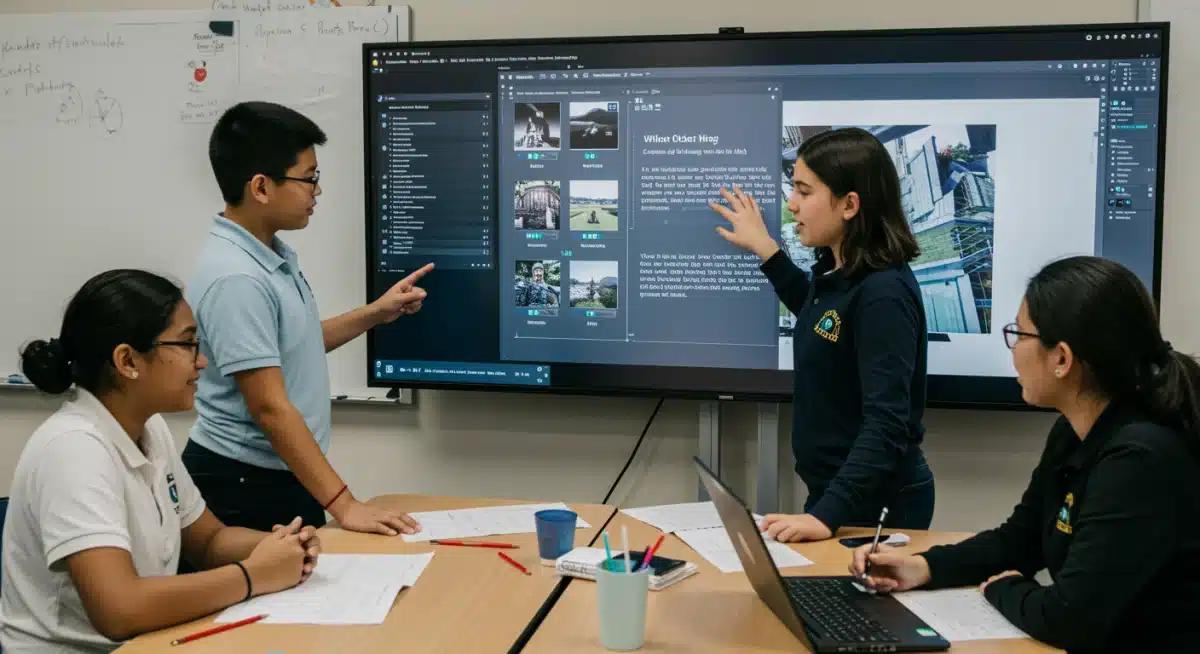
AI’s capabilities in content generation are proving invaluable for teachers in developing engaging and diverse educational materials. From creating customized worksheets to generating creative writing prompts, AI streamlines curriculum design.
By Spring 2026, K-12 teachers will likely be using AI to rapidly produce differentiated assignments, lesson plans, and even multimedia content tailored to specific learning objectives and student interests. This saves significant preparation time.
This application of AI in US Education empowers educators to innovate their teaching practices, moving away from generic resources to highly relevant and stimulating learning experiences that truly resonate with students.
Streamlining Teacher Workflows with AI Content Tools
Teachers can leverage AI to quickly generate variations of a quiz, create accessible summaries of complex texts, or design interactive activities. This automation allows for greater creativity in instructional design.
The ability to generate content on demand means that teachers can respond more quickly to classroom needs and adapt lessons based on student feedback. It’s a powerful tool for maintaining a dynamic and responsive curriculum.
- Rapid creation of diverse educational materials.
- Customization of content for varied student needs.
- Time savings in lesson planning and resource development.
- Enhanced creativity in curriculum design.
Tool 4: AI-Powered Data Analytics for Instructional Improvement
AI-driven data analytics platforms offer K-12 teachers unprecedented insights into student learning patterns and instructional effectiveness.
These tools process vast amounts of data to identify trends, predict performance, and highlight areas for pedagogical adjustment.
As AI in US Education becomes more sophisticated, teachers will use these analytics to refine their teaching strategies, optimize interventions, and ensure that every student is on track for success. This data-informed approach is transformative.
By Spring 2026, understanding and utilizing these analytical insights will be a core competency for many educators, enabling them to make more strategic decisions about their teaching and classroom management.
Leveraging Data for Targeted Interventions
These platforms can identify students at risk of falling behind before it becomes a significant issue, allowing teachers to intervene proactively. They also pinpoint specific concepts where a large number of students are struggling.
Teachers can use this information to adjust their teaching methods, provide additional resources, or create small group sessions focused on particular challenges. This precision in intervention maximizes positive impact on student outcomes.
- Early identification of at-risk students.
- Pinpointing common areas of student difficulty.
- Informing data-driven instructional adjustments.
- Optimizing resource allocation for student support.
Challenges and Ethical Considerations for AI in US Education
While the benefits of AI in US Education are substantial, it’s crucial to address the challenges and ethical considerations that accompany its widespread adoption. Data privacy, algorithmic bias, and equitable access are paramount concerns.
Schools must implement robust policies to protect student data and ensure that AI algorithms are fair and unbiased, not inadvertently perpetuating existing inequalities. Professional development for teachers on ethical AI use is also essential.
Addressing these issues proactively will ensure that AI serves as a truly beneficial force in K-12 education, fostering an inclusive and secure learning environment for all students. This requires ongoing dialogue and policy refinement.
Ensuring Equitable Access and Digital Literacy
The digital divide remains a significant concern, and ensuring all students have access to AI tools and the necessary digital literacy to use them effectively is critical. Schools and districts must invest in infrastructure and training.
Moreover, teaching students about AI, how it works, and its ethical implications is crucial for preparing them for a future where AI will be ubiquitous. Digital citizenship must evolve to include AI literacy.
- Addressing disparities in access to technology.
- Developing comprehensive digital literacy curricula.
- Educating students on AI ethics and critical evaluation.
- Providing ongoing professional development for educators.
| Key Tool | Primary Benefit for Teachers |
|---|---|
| Adaptive Learning Platforms | Personalizes instruction, optimizes student learning paths. |
| AI Tutoring Systems | Provides on-demand student support and reinforces concepts. |
| AI Content Generation | Streamlines curriculum design and material creation. |
| AI Data Analytics | Offers insights for instructional improvement and targeted interventions. |
Frequently Asked Questions About AI in US Education
The rise of AI in US Education means teachers will gain powerful tools to personalize learning, automate administrative tasks, and access data-driven insights. It shifts their role towards mentorship and strategic instructional design, enhancing their capacity to meet diverse student needs effectively.
Yes, many of these AI tools are already in various stages of pilot and broader implementation. By Spring 2026, their maturity, accessibility, and integration capabilities are expected to allow for widespread adoption by K-12 teachers across US education systems.
Student privacy is a critical concern with AI in US Education. Robust data protection policies, secure platforms, and clear consent processes are essential. Schools and developers are working to ensure compliance with regulations like FERPA, protecting student data while leveraging AI benefits.
Teachers will require professional development focused on understanding AI functionalities, ethical use, and pedagogical integration. Training should cover practical application, data interpretation, and how to effectively blend AI tools with traditional teaching methods to maximize student learning outcomes.
No, AI is not expected to replace human teachers. Instead, it serves as a powerful assistant, augmenting teachers’ capabilities by handling repetitive tasks and providing insights. The human element of empathy, critical thinking, and social-emotional development remains irreplaceable in K-12 education.
Looking Ahead: The Future of AI in US Education
The integration of AI in US Education is not a fleeting trend but a fundamental shift that will redefine teaching and learning for generations.
In conclusion, the four practical tools discussed represent just the beginning of what’s possible, setting a precedent for deeper and more sophisticated applications.
As we approach Spring 2026, the focus will remain on ensuring these technologies are implemented ethically, equitably, and effectively, maximizing their potential to foster student success and empower educators.
The conversation will evolve to include new innovations and best practices. The transformative journey of AI in US Education requires continuous adaptation, research, and collaboration among educators, policymakers, and technology developers.
For a deeper dive into the federal roadmap for these technologies, you can read the official report on AI and the future of teaching and learning.