Higher Education Affordability: 4 Innovative Models U.S. Colleges Piloting in 2026
Anúncios
In 2026, the landscape of higher education is undergoing a fundamental structural transition defined by “Tuition Architecture Innovation.”
Driven by widespread public concern over institutional sticker shock, universities are moving beyond traditional financial aid structures.
This critical update details Higher Education Affordability, focusing on what changed, why it matters, and how these proactive pilot programs aim to permanently reduce student reliance on heavy debt while enhancing access for diverse socioeconomic backgrounds.
The Rising Cost of Higher Education: A National Concern
The persistent increase in tuition fees and associated living expenses has made a college degree an increasingly distant dream for many American families.
This trend has fueled a national debate about the sustainability of the current higher education funding model. Student loan debt has surpassed staggering figures, creating a long-term economic challenge for millions.
Policymakers, educators, and economists agree that radical changes are necessary to address this growing crisis. Without significant intervention, the access gap will continue to widen, impacting social mobility and economic competitiveness.
The pressure on institutions to find viable solutions is immense.
The quest for enhanced higher education affordability is not merely an academic exercise; it is a societal imperative.
These challenges necessitate creative and bold initiatives that move beyond incremental adjustments, ushering in a new era of educational financing. The urgency of this situation cannot be overstated as the 2026 pilot programs commence.
Model 1: Income-Share Agreements (ISAs) Expansion
One of the most widely discussed and potentially transformative models is the expanded use of Income-Share Agreements (ISAs).
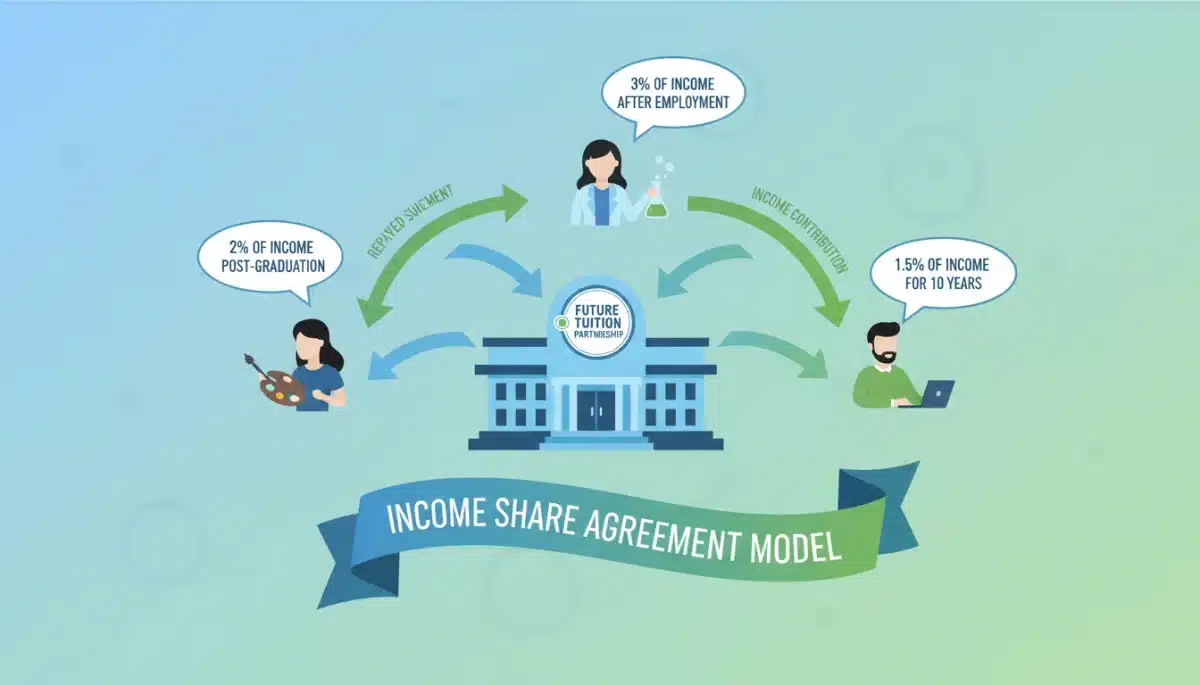
Under an ISA, students receive funding for their education in exchange for a percentage of their future income for a set period after graduation. This model aligns the financial incentives of the institution with the success of its graduates.
Several institutions are expanding their ISA programs in 2026, often targeting specific high-demand fields of study.
The core idea is to reduce upfront costs and shift the financial risk from the student to the university, fostering a partnership approach.
This innovative solution directly tackles the issue of higher education affordability by linking repayment to earning potential.
Critics of ISAs often raise concerns about transparency, repayment terms, and the potential for disproportionate impact on graduates in lower-paying fields.
However, proponents argue that well-structured ISAs can provide a safety net, ensuring that repayment obligations are manageable and contingent on actual post-graduation earnings.
This model is a promising avenue for improving higher education affordability.
How ISAs are structured in pilot programs
Participating colleges are designing ISAs with clear caps on total repayment and income thresholds, ensuring graduates are not overburdened. They are also focusing on programs with strong job placement rates to mitigate risk.
This meticulous structuring aims to balance institutional sustainability with student protection, making ISAs a more attractive option.
The pilot programs are collecting extensive data to assess the long-term viability and equity of these agreements. This data will be crucial in refining ISA models and potentially expanding their adoption across a wider range of institutions.
The success of these pilots could redefine how students finance their degrees, significantly boosting higher education affordability.
- Repayment percentages typically range from 2% to 10% of gross income.
- Payment periods are usually fixed, often between 5 and 10 years.
- Income thresholds ensure no payments are made if earnings fall below a certain level.
- Total repayment caps prevent students from paying back excessive amounts.
Model 2: Competency-Based Education (CBE) with Fixed Pricing
Competency-Based Education (CBE) models are gaining traction as a way to accelerate degree completion and reduce overall costs.
Instead of credit hours, students advance based on demonstrated mastery of specific skills and knowledge. This allows motivated students to finish their degrees faster, directly impacting higher education affordability.
In 2026, several U.S. colleges are piloting CBE programs with fixed, often lower, pricing structures, moving away from traditional per-credit tuition.
This innovative approach recognizes that learning can occur at different paces and through various means, not just seat time. The emphasis is on outcomes and efficiency, which can lead to significant cost savings.
By decoupling learning from traditional time-based metrics, CBE offers flexibility and personalization, which can be particularly beneficial for adult learners or those with prior learning experiences.
The fixed pricing model provides predictability, allowing students to budget more effectively and mitigating financial surprises. This directly addresses concerns about higher education affordability.
Benefits of CBE for students
Students in CBE programs can often leverage prior learning, work experience, or self-study to test out of modules, thereby shortening their time to degree.
This efficiency translates directly into lower tuition costs and reduced living expenses associated with prolonged enrollment. The focus on practical skills also enhances employability.
The fixed pricing structure, regardless of how quickly a student completes the competencies, offers a clear financial advantage.
This transparency allows students to make informed decisions about their educational investment. The integration of CBE with fixed pricing is a powerful combination for improving higher education affordability.
- Accelerated degree completion for self-paced learners.
- Recognition of prior learning and work experience.
- Transparent and predictable tuition costs.
- Focus on demonstrable skills relevant to the job market.
Model 3: Employer-Sponsored Tuition Partnerships
A growing number of U.S. colleges are forging direct partnerships with employers to offer tuition benefits and pathways to degrees for their employees.
These employer-sponsored tuition partnerships represent a significant step towards improving higher education affordability by shifting the financial responsibility from the individual to the employer.
This symbiotic relationship benefits both parties.
In 2026, new pilot programs are expanding beyond traditional tuition reimbursement, with some companies directly funding specific degree programs relevant to their workforce needs.
This model often includes dedicated academic advisors and tailored curricula, ensuring that the education received directly translates into career advancement opportunities. Such partnerships are vital for enhancing higher education affordability.
These initiatives address not only the cost of education but also the skills gap in various industries, creating a pipeline of qualified talent.
The strategic alignment between academic institutions and corporate partners is a win-win, fostering workforce development while making education more accessible. This collaborative approach directly tackles issues of higher education affordability.
Key features of these partnerships
These partnerships often involve employers paying tuition directly, sometimes covering a significant portion or even the entirety of the cost.
They may also include paid time off for studies, mentorship programs, and guaranteed employment upon graduation. Such comprehensive support structures make higher education significantly more accessible.
For institutions, these partnerships provide a stable enrollment source and opportunities for curriculum development informed by industry needs.
For students, it means a clear path to a degree with reduced or eliminated personal financial burden, along with valuable work experience. This model is a powerful lever for improving higher education affordability.
- Direct tuition funding by employers.
- Curricula tailored to industry demands.
- Opportunities for professional development and mentorship.
- Reduced or eliminated student debt for participating employees.
Model 4: Tuition-Free Community College Initiatives with Transfer Pathways
The concept of tuition-free community college is not entirely new, but in 2026, several states and localities are piloting expanded initiatives that include robust transfer pathways to four-year institutions.
This model aims to create a more seamless and affordable route to a bachelor’s degree, significantly boosting higher education affordability at the foundational level.
These pilot programs focus on guaranteed admission agreements, streamlined credit transfer, and enhanced advising services between community colleges and partner universities.
The goal is to ensure that students can begin their higher education journey without tuition costs and then transition smoothly into a four-year program, minimizing financial and academic hurdles.
This is a crucial step for higher education affordability.
By offering the first two years of college tuition-free, these initiatives drastically reduce the overall cost of a bachelor’s degree, making it accessible to a broader demographic.
This approach tackles the financial barrier at its earliest point, allowing students to build a strong academic foundation before incurring significant debt. This innovative model directly addresses higher education affordability.
Impact on student access and success
These programs are designed to attract students who might otherwise consider higher education financially out of reach.
By removing the initial tuition barrier, community colleges become a viable entry point for diverse learners, including those from low-income backgrounds.
The structured transfer pathways ensure academic continuity and support student success in their transition to a four-year university.
The emphasis on strong advising and clear articulation agreements helps students avoid losing credits during transfer, a common issue that can prolong degree completion and increase costs.
This integrated approach not only improves access but also ensures efficiency in the educational journey, making a significant impact on higher education affordability.
- Elimination of tuition costs for the first two years of college.
- Guaranteed admission and seamless credit transfer to partner universities.
- Enhanced academic advising and support services.
- Reduced overall cost of a bachelor’s degree.
Challenges and Opportunities for These Models
While these innovative models offer significant promise for improving higher education affordability, they also present various challenges.
Funding sustainability for tuition-free programs, the scalability of employer partnerships, and the regulatory complexities surrounding ISAs are all critical considerations.
Institutions must navigate these hurdles carefully to ensure long-term success.
The political will to support these initiatives through state and federal funding remains a crucial factor, especially for large-scale tuition-free programs.
Furthermore, ensuring equitable access and outcomes across diverse student populations will require ongoing monitoring and adjustments. The commitment to higher education affordability must be sustained through continuous evaluation.
Despite these challenges, the opportunities presented by these models are substantial. They have the potential to democratize access to higher education, reduce the burden of student debt, and foster a more skilled workforce.
The success of these pilot programs could pave the way for widespread adoption, fundamentally transforming the landscape of higher education affordability.
Measuring the Impact on Student Debt and Access
A primary objective of these pilot programs is to quantitatively measure their impact on student loan debt and overall access to higher education.
Data collection and rigorous analysis will be pivotal in determining the efficacy of each model. Early indicators suggest positive trends in enrollment and reduced reliance on traditional loans, directly addressing higher education affordability.
Researchers are tracking key metrics such as student retention rates, graduation rates, post-graduation employment, and average student loan burdens.
Longitudinal studies will provide insights into the long-term financial well-being of participants compared to those in traditional funding models. These comprehensive evaluations are essential for proving the value of improved higher education affordability.
The findings from these evaluations will inform future policy decisions and institutional strategies regarding educational financing.
A demonstrated reduction in student debt coupled with increased access for underserved populations would provide compelling evidence for broader implementation of these innovative models, cementing their role in future higher education affordability efforts.
The Role of Technology in Enhancing Affordability
Technology plays an increasingly vital role in supporting and expanding these innovative models for higher education affordability.
Online learning platforms, adaptive learning tools, and data analytics are being leveraged to deliver education more efficiently and personalize learning experiences.
This integration helps reduce operational costs and enhance student engagement, directly contributing to higher education affordability.
For instance, CBE programs heavily rely on robust learning management systems to track competency mastery and provide individualized feedback.
Online components in employer-sponsored programs offer flexibility for working professionals, removing geographical barriers.
Technology is not just a tool; it’s an enabler of these new approaches, significantly enhancing higher education affordability.
Furthermore, artificial intelligence and predictive analytics are being used to identify at-risk students, optimize resource allocation, and improve advising services, preventing students from dropping out due to financial or academic struggles.
The strategic application of technology is crucial for scaling these initiatives and ensuring their long-term success in promoting higher education affordability.
Future Outlook: A Shifting Landscape
The pilot programs launched in 2026 signal a significant shift in how U.S. colleges are approaching higher education affordability.
The lessons learned from these initiatives will undoubtedly shape the future of educational financing.
As institutions continue to experiment and adapt, a more diverse and equitable landscape for higher education may emerge. The ongoing evolution of these models is critical for sustained higher education affordability.
The coming years will likely see a blend of these innovative models, customized to fit the specific needs and missions of different institutions.
Collaboration between government, education, and industry sectors will be essential to sustain these efforts and expand their reach.
The commitment to addressing higher education affordability is a collective responsibility that demands continuous innovation.
Ultimately, the success of these models will be measured by their ability to provide quality education without creating insurmountable financial barriers.
The goal is to ensure that a college degree remains a pathway to opportunity, not a source of lifelong debt. The future of higher education affordability depends on the continued development and refinement of these groundbreaking strategies.
| Innovative Model | Brief Description |
|---|---|
| Income-Share Agreements | Students repay a percentage of future income, aligning risk with universities. |
| Competency-Based Education | Fixed pricing for skill mastery, allowing faster, cheaper degree completion. |
| Employer-Sponsored Tuition | Companies directly fund employee education, reducing individual burden. |
| Tuition-Free Community College | Free initial years with clear transfer pathways to four-year institutions. |
Frequently Asked Questions About Higher Education Affordability Models
What are the primary goals of these new affordability models?▼The main goals are to reduce the financial burden on students, increase access to higher education for diverse populations, and innovate traditional funding structures. These models aim to make college degrees more attainable and sustainable in the long term, directly addressing the crisis of higher education affordability.
How do Income-Share Agreements (ISAs) differ from traditional student loans?▼ISAs differ fundamentally because repayment is tied to a graduate’s future income, not a fixed loan amount. If a graduate earns below a certain threshold, they pay nothing. This shifts financial risk from the student to the institution, unlike traditional loans with fixed payments regardless of income, improving higher education affordability.
Can Competency-Based Education (CBE) truly save students money?▼Yes, CBE can save students money by allowing them to advance based on mastery rather than seat time. This means faster degree completion for some, reducing overall tuition and living expenses. Fixed pricing models in CBE programs also offer cost predictability, enhancing higher education affordability significantly.
What role do employers play in enhancing higher education affordability?▼Employers are increasingly partnering with colleges to fund employee tuition, offer mentorship, and align curricula with industry needs. This direct financial support and career pathway integration significantly reduce the cost burden on individual students, making higher education more accessible and relevant for workforce development, thus boosting higher education affordability.
How will tuition-free community colleges impact four-year universities?▼Tuition-free community colleges with robust transfer pathways will likely increase the pool of students prepared to enter four-year universities. This provides a more affordable entry point into higher education, potentially diversifying university student bodies and fostering stronger academic preparedness, ultimately supporting broader higher education affordability.
Looking Ahead: The Future of College Funding
The pilot programs for Higher Education Affordability: 4 Innovative Models U.S. Colleges Are Piloting in 2026 are more than mere experiments; they represent a concerted effort to redefine the economic realities of pursuing a college degree.
The insights gained from these initiatives will be crucial in shaping national policies and institutional strategies for years to come.
Stakeholders must continue to monitor the outcomes, assess scalability, and advocate for sustainable funding mechanisms.
The ongoing dialogue about student debt and access to quality education underscores the urgency of these innovations.
As these models evolve, they promise to create a more equitable and accessible higher education landscape.
The ultimate goal is to ensure that financial constraints do not deter deserving students from achieving their academic and career aspirations.
The path to universal higher education affordability is complex, but these four innovative models offer tangible steps forward.
Their success will determine how future generations access and finance their education, marking a pivotal moment in American educational history. The commitment to these solutions will pave the way for a more educated and economically resilient society.
To track these cost trends and examine institutional metrics, students and policymakers can access the U.S. Department of Education’s Higher Education College Affordability and Transparency Portal.