Maximizing Social Security Benefits: 2026 Retiree Strategies

Anúncios
Latest developments on Maximizing Your Social Security Benefits: 3 Key Strategies for 2026 Retirees, with key facts, verified sources and what readers need to monitor next in Estados Unidos, presented clearly in Inglês (Estados Unidos) (en-US).
Maximizing Your Social Security Benefits: 3 Key Strategies for 2026 Retirees is shaping today’s agenda with new details released by officials and industry sources. This update prioritizes what changed, why it matters and what to watch next, in a straightforward news format.
For those approaching retirement in 2026, understanding how to optimize Social Security is paramount. The decisions made now will significantly impact financial well-being for decades to come, making informed choices essential.
Anúncios
This article delves into the critical strategies and considerations for Maximizing Your Social Security Benefits, providing a clear roadmap for future retirees. We will explore claiming ages, spousal benefits, and the implications of continuing to work, offering practical insights.
Understanding Your Full Retirement Age (FRA)
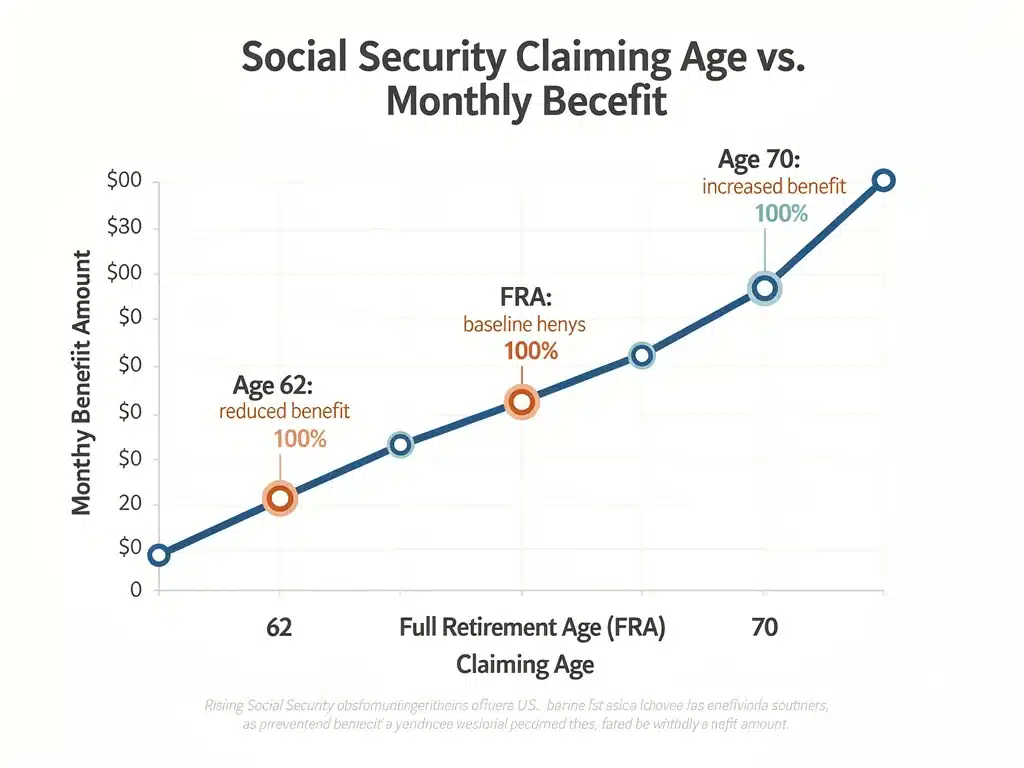
Your Full Retirement Age (FRA) is a cornerstone of Social Security planning, directly influencing the amount of benefits you receive. For those born in 1960 or later, including 2026 retirees, the FRA is 67. Claiming benefits before this age results in a permanent reduction.
Conversely, delaying benefits past your FRA can significantly increase your monthly payments. Each year you delay, up to age 70, your benefits grow by a certain percentage, known as Delayed Retirement Credits (DRCs).
Anúncios
This critical decision point requires careful consideration of personal health, financial needs, and other income sources. Understanding the mechanics of FRA is the first step in Maximizing Your Social Security Benefits.
The Impact of Early Claiming
Claiming Social Security benefits as early as age 62 is an option for many, but it comes with a substantial reduction in monthly payments. This reduction is permanent and can significantly diminish your total lifetime benefits.
While immediate access to funds can be appealing, especially if facing health issues or job loss, the long-term financial implications are considerable. Early claiming can reduce your monthly benefit by up to 30%, a factor critical for Maximizing Your Social Security Benefits.
Therefore, a thorough analysis of your financial situation and expected longevity is essential before making this decision. The trade-off between immediate income and a larger future payout must be carefully weighed.
Benefits of Delayed Claiming
Delaying Social Security benefits beyond your Full Retirement Age, up to age 70, offers a powerful way to increase your monthly income. For each year you delay, your benefit amount increases by 8%, thanks to Delayed Retirement Credits.
This strategy can lead to a significantly higher monthly payment, potentially providing a much-needed boost to your retirement income. For a 2026 retiree, delaying until 70 could mean a 24% increase over your FRA benefit.
This approach is particularly beneficial for those who are healthy, have other sources of income, or anticipate a long lifespan. It’s a key strategy for Maximizing Your Social Security Benefits over the long term.
Strategic Considerations for Spousal Benefits
Spousal benefits offer a valuable opportunity for married couples to enhance their collective Social Security income. This provision allows one spouse to claim benefits based on the earnings record of the other spouse, even if they have little or no work history themselves.
The rules governing spousal benefits can be complex, but understanding them is crucial for Maximizing Your Social Security Benefits as a couple. Strategic planning can unlock significant additional income throughout retirement.
This often involves coordinating claiming ages between spouses to achieve the highest possible combined benefit. These decisions require careful thought and often professional guidance.
Coordinating Claiming Ages for Couples
For married couples, coordinating when each spouse claims their Social Security benefits is a powerful strategy. One common approach is for the lower-earning spouse to claim early, while the higher-earning spouse delays until age 70.
This allows the couple to have some income stream while the larger benefit grows. When the higher-earning spouse claims, the lower-earning spouse may then switch to a higher spousal benefit if it exceeds their own.
This coordinated effort is a cornerstone of Maximizing Your Social Security Benefits for two. It ensures that both individual and spousal benefits are utilized to their fullest potential.
- One spouse claims early to provide immediate income.
- The other spouse delays claiming to maximize their own benefit, which also maximizes the potential survivor benefit.
- The lower-earning spouse can switch to a higher spousal benefit later if applicable.
Understanding Survivor Benefits
Survivor benefits are another critical component of Social Security planning for couples. When one spouse passes away, the surviving spouse may be eligible to receive benefits based on the deceased spouse’s earnings record.
The amount of the survivor benefit is directly tied to the deceased spouse’s benefit at the time of their death. This means that if the higher-earning spouse delayed claiming, the survivor benefit will also be higher.
Considering survivor benefits is essential for long-term financial security, particularly for the surviving spouse. It’s a significant factor in Maximizing Your Social Security Benefits and ensuring protection.
The Impact of Working While Receiving Benefits
For many 2026 retirees, the idea of continuing to work, even part-time, is appealing for both financial and personal reasons. However, working while receiving Social Security benefits can impact your payment amounts, especially if you claim before your Full Retirement Age.
The Social Security Administration (SSA) has specific earnings limits that, if exceeded, can lead to a temporary reduction or withholding of benefits. Understanding these limits is vital for Maximizing Your Social Security Benefits without unexpected surprises.
These rules are designed to balance income replacement with the incentive to continue working. Navigating them effectively requires careful planning and awareness of current thresholds.
Earnings Limits Before Full Retirement Age
If you claim Social Security benefits before your Full Retirement Age and continue to work, your benefits may be reduced if your earnings exceed specific annual limits. For 2026, these limits will be updated, but the principle remains consistent.
The SSA will deduct $1 from your benefits for every $2 you earn above the annual limit. This can significantly impact your net Social Security income, making it crucial to monitor your earnings.
This reduction is not permanent; benefits are recalculated at your FRA to account for any withheld amounts. Nonetheless, it’s a critical consideration for Maximizing Your Social Security Benefits in the short term.
Earnings Limits in the Year You Reach FRA
In the year you reach your Full Retirement Age, the earnings limit rules change significantly. For the months leading up to your FRA, a higher earnings limit applies, and the reduction rate is different.
The SSA will deduct $1 from your benefits for every $3 you earn above a higher limit, until the month you reach your FRA. Once you reach your FRA, earnings limits no longer apply, and you can earn as much as you want without penalty.
This transition year requires careful tracking of income to avoid unexpected benefit reductions. It’s a key detail for Maximizing Your Social Security Benefits during this pivotal period.
Understanding these rules is essential for those planning to work part-time in retirement. It allows for strategic adjustments to income and claiming strategies, further aiding in Maximizing Your Social Security Benefits.
Navigating Social Security Taxation
For many retirees, Social Security benefits are not entirely tax-free. A portion of your benefits may be subject to federal income tax, depending on your combined income. This is an important consideration when planning your retirement finances.
Your combined income includes your adjusted gross income, tax-exempt interest, and half of your Social Security benefits. Understanding these thresholds is crucial for financial forecasting and Maximizing Your Social Security Benefits net value.
State income taxes on Social Security also vary, with some states taxing benefits and others not. This adds another layer of complexity to the overall financial picture for 2026 retirees.
Federal Taxation Thresholds
The federal taxation of Social Security benefits begins when your combined income exceeds certain thresholds. For single filers, if your combined income is between $25,000 and $34,000, up to 50% of your benefits may be taxable.
If your combined income exceeds $34,000, up to 85% of your benefits may be subject to federal income tax. For those filing jointly, the thresholds are $32,000 to $44,000 for 50% taxation and over $44,000 for up to 85% taxation.
These thresholds are not indexed for inflation, meaning more retirees may find their benefits taxed over time. This aspect significantly influences the true value of Maximizing Your Social Security Benefits.
State-Specific Tax Implications
Beyond federal taxes, several states also tax Social Security benefits. As of current reporting, states like Colorado, Connecticut, Kansas, Minnesota, Missouri, Montana, Nebraska, New Mexico, Rhode Island, Utah, Vermont, and West Virginia tax Social Security to some extent.
The specific rules and exemptions vary significantly from state to state. Some states offer exemptions based on income level, while others provide credits or deductions.
Understanding your state’s particular tax laws is crucial for a comprehensive retirement plan. This regional variation plays a role in the overall strategy for Maximizing Your Social Security Benefits.
Reviewing Your Social Security Statement
Your annual Social Security Statement is an invaluable tool for retirement planning. It provides a personalized estimate of your future benefits based on your earnings record and different claiming ages.
Regularly reviewing this statement ensures that your earnings record is accurate and helps you project your potential benefits more precisely. Any discrepancies should be addressed promptly with the Social Security Administration.
This document serves as a foundational element in any strategy aimed at Maximizing Your Social Security Benefits. It offers a clear snapshot of your current standing and future potential.
Checking Your Earnings Record
It is imperative to regularly check your Social Security earnings record for accuracy. Errors in your earnings history can lead to lower benefits than you are entitled to, potentially impacting your retirement income significantly.
You can access your earnings record by creating an account on the SSA’s website. Reviewing it annually allows you to identify and correct any mistakes before they become more difficult to resolve.
An accurate earnings record is fundamental to Maximizing Your Social Security Benefits. It ensures that all your contributions are properly credited and reflected in your future payments.
Estimating Future Benefits
Your Social Security Statement also provides estimates for your benefits at different claiming ages: 62, your Full Retirement Age, and 70. These estimates are crucial for comparing various claiming strategies.
Using these estimates, you can model different scenarios to determine the optimal time to claim based on your personal financial goals and health outlook. This foresight is key to making informed decisions.
These projections are instrumental in the process of Maximizing Your Social Security Benefits, allowing you to visualize the financial impact of each choice. It empowers you to plan proactively for your retirement.

Consulting a Financial Advisor
Given the complexities of Social Security rules and their significant impact on retirement income, consulting a qualified financial advisor is often a wise decision. An advisor can provide personalized guidance tailored to your unique financial situation.
They can help you navigate the various claiming strategies, understand the implications of different choices, and integrate Social Security into your broader retirement plan. This expert insight can be invaluable for Maximizing Your Social Security Benefits.
A professional can offer a holistic view, considering all aspects of your financial life to create a cohesive and effective strategy. Their expertise ensures that no potential benefit is overlooked.
Personalized Claiming Strategies
A financial advisor can help you develop a personalized claiming strategy that aligns with your specific needs and goals. They will consider factors such as your health, other retirement savings, and spousal benefits.
This tailored approach goes beyond general advice, offering concrete recommendations based on a thorough analysis of your individual circumstances. Such personalized guidance is critical for Maximizing Your Social Security Benefits effectively.
They can also help you understand the long-term impact of your decisions, providing clarity and confidence in your retirement planning. This can make a significant difference in your financial security.
Integrating Social Security with Other Retirement Assets
Social Security is just one component of your overall retirement income. A financial advisor can help you integrate your Social Security benefits with other assets, such as 401(k)s, IRAs, and pensions.
This holistic approach ensures that all your financial resources work together efficiently to support your retirement lifestyle. They can advise on withdrawal strategies and tax-efficient planning.
Effective integration is key to a well-rounded retirement plan and paramount for Maximizing Your Social Security Benefits in conjunction with your other investments. It creates a robust financial foundation.
| Key Strategy | Brief Description |
|---|---|
| Delay Claiming | Maximize monthly benefits by waiting until age 70 for 8% annual growth. |
| Coordinate Spousal Benefits | Couples can strategically claim to optimize combined household income. |
| Understand Earnings Limits | Avoid benefit reductions if working before Full Retirement Age. |
| Review Statements | Verify earnings record and estimate future benefits accurately. |
Frequently Asked Questions About Social Security Benefits
The best age depends on individual circumstances, including health, financial needs, and longevity expectations. While claiming at 70 maximizes monthly payments, claiming at Full Retirement Age is often a balanced approach. Early claiming at 62 provides immediate income but with a permanent reduction.
A spouse can claim up to 50% of their partner’s Full Retirement Age benefit, provided their own benefit is lower. Strategic coordination, such as one spouse delaying, can optimize the combined household benefit. This is a key aspect of Maximizing Your Social Security Benefits for couples.
Yes, if you claim benefits before your Full Retirement Age and earn above specific limits, your benefits may be reduced. However, these reductions are temporary, and your benefits are recalculated at your FRA. After FRA, there are no earnings limits.
A portion of your Social Security benefits may be subject to federal income tax if your combined income exceeds certain thresholds. Some states also tax Social Security benefits, so it’s important to check your state’s specific tax laws and plan accordingly for Maximizing Your Social Security Benefits net value.
Regularly reviewing your Social Security statement ensures your earnings record is accurate, which directly impacts your future benefit calculations. It also provides personalized benefit estimates at different claiming ages, crucial for effective retirement planning and Maximizing Your Social Security Benefits.
Looking Ahead: Ensuring a Secure Retirement
The landscape of retirement planning, particularly concerning Social Security, is constantly evolving. For 2026 retirees, proactively understanding and implementing strategies for Maximizing Your Social Security Benefits is not just advisable, but essential. The decisions made today will resonate throughout your entire retirement, impacting your financial stability and quality of life.
By focusing on informed choices regarding claiming age, leveraging spousal and survivor benefits, and understanding the implications of continued work, retirees can significantly enhance their financial outlook. Continuous monitoring of Social Security rules and personal financial health remains paramount.
Engaging with financial professionals and staying updated on policy changes will empower you to adapt and optimize your strategy. The goal is to secure a comfortable and worry-free retirement by diligently pursuing Maximizing Your Social Security Benefits.