Qualifying for 2026 Medicare Extra Help: Save $5,000+

Anúncios
The 2026 Medicare Extra Help Benefit provides significant financial relief for eligible beneficiaries, offsetting prescription drug plan premiums, deductibles, and copays to save recipients over $5,000 annually.
Administered by the Social Security Administration (SSA), updated income and resource limits for 2026 make reviewing qualification guidelines essential.
This step-by-step guide details how to navigate the application process and secure critical prescription cost assistance.
Anúncios
Understanding the Medicare Extra Help Benefit
The Medicare Extra Help program, officially known as the Low-Income Subsidy (LIS), is designed to assist Medicare beneficiaries with limited income and resources in paying for their Medicare prescription drug plan (Part D) costs.
This benefit can dramatically reduce out-of-pocket expenses, making essential medications more affordable.
For 2026, the program continues its mission to provide financial relief, potentially saving eligible individuals thousands of dollars each year.
Anúncios
These savings can cover monthly premiums, annual deductibles, and a portion of prescription co-payments, directly impacting a beneficiary’s financial stability and access to necessary treatments.
The Extra Help benefit is a federal program, and its guidelines are established by the Social Security Administration in conjunction with Medicare.
It represents a significant component of Medicare’s efforts to ensure that prescription drugs remain accessible to those who need them most, regardless of their income level.
What Extra Help Covers
The Extra Help program provides comprehensive financial assistance for Medicare Part D costs.
This includes help with monthly premiums, which can vary significantly between plans, and the annual deductible that beneficiaries must meet before their plan starts paying for medications.
Additionally, it reduces co-payments for prescription drugs, often to as little as a few dollars per prescription.
The level of assistance depends on an individual’s income and resources, with some beneficiaries receiving full subsidies and others receiving partial help.
- Reduced or eliminated Part D monthly premiums
- Lowered or waived annual Part D deductibles
- Significantly reduced co-payments for covered prescription drugs
- Protection against the Medicare Part D coverage gap (donut hole)
Eligibility Basics for 2026
Eligibility for the 2026 Medicare Extra Help Benefit is primarily based on income and resource limits set by the federal government.
These limits are subject to change annually, so staying informed about the most current figures is crucial for anyone considering applying.
Generally, applicants must be enrolled in Medicare Part A and/or Part B, reside in one of the 50 states or the District of Columbia, and meet specific financial criteria.
The Social Security Administration evaluates each application based on these factors, determining the level of assistance an individual will receive.
It is important to note that certain types of income and resources are excluded from these calculations, which can impact an individual’s overall eligibility.
Understanding these exclusions is a key part of accurately assessing one’s potential for qualifying for the 2026 Medicare Extra Help Benefit.
Income and Resource Limits for 2026
The Social Security Administration sets specific income and resource limits for the Medicare Extra Help program, which are updated annually.
For 2026, these thresholds are designed to ensure that the benefit reaches those most in need, providing a critical safety net for prescription drug costs.
Understanding these limits is the first crucial step in determining your eligibility. It is not just about your monthly income, but also about the value of your assets, though many common assets are excluded from the calculation.
Both individual and married couple limits apply, with slightly higher thresholds for couples.
These limits are non-negotiable, and exceeding them, even slightly, can affect the level of assistance or even disqualify an applicant.
Therefore, a careful review of your financial situation against the 2026 guidelines is paramount for anyone considering applying for the 2026 Medicare Extra Help Benefit.
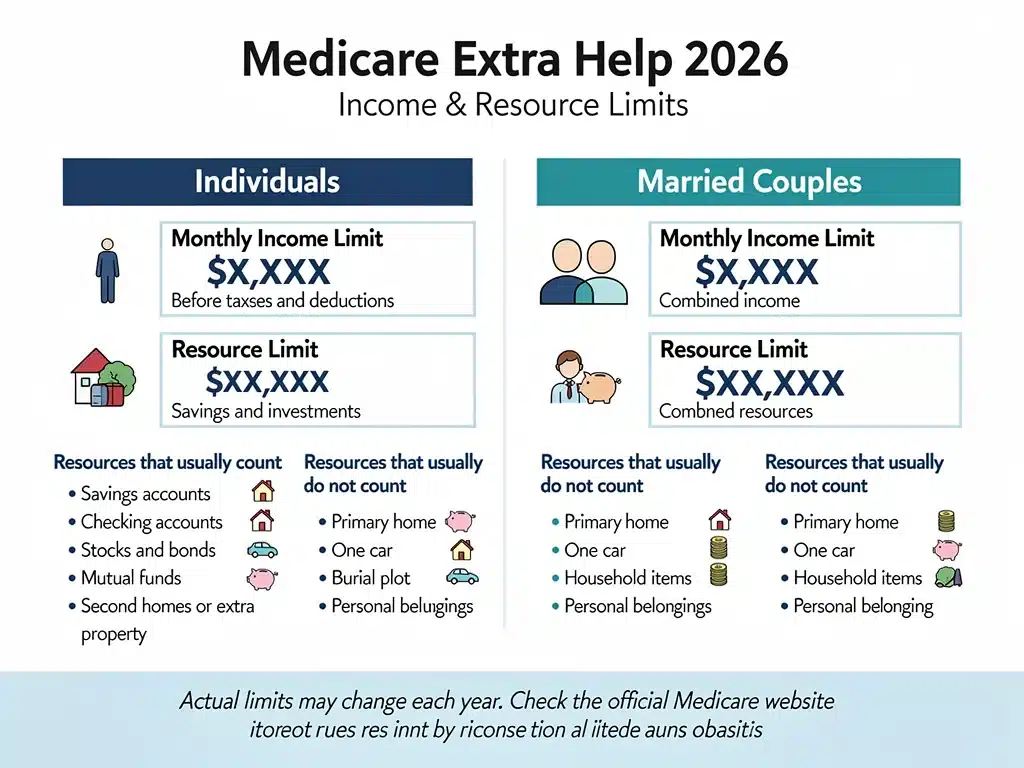
Income limits for the 2026 Medicare Extra Help Benefit typically fall around 150% of the federal poverty level.
This means that if your annual income, after certain deductions, is below this threshold, you may qualify. The exact figures will be released closer to the enrollment period, but planning based on current trends is advisable.
Resources, which include savings accounts, stocks, and bonds, also have limits. However, your primary home, one vehicle, household goods, and personal items are generally not counted.
This distinction is vital, as many beneficiaries mistakenly believe their home equity will disqualify them.
It is advisable to consult the official Social Security Administration website or contact them directly for the most precise and up-to-date income and resource limits for 2026.
This ensures you have the accurate information needed to assess your eligibility for the 2026 Medicare Extra Help Benefit.
Counting Your Income
When assessing your income for the Medicare Extra Help program, the Social Security Administration considers various sources, including Social Security benefits, pensions, wages, and interest from investments.
However, certain types of income are disregarded, which can help more people qualify.
Examples of disregarded income include some income from scholarships, federal disaster assistance, and certain infrequent or irregular income.
It is essential to accurately report all income sources while also being aware of what can be excluded from the calculation.
- Social Security benefits (after Medicare Part B premiums)
- Pensions and annuities
- Wages and self-employment income
- Interest and dividends from investments
Evaluating Your Resources
Resources, for the purpose of Extra Help, refer to money and other assets that can be converted to cash and used for support.
This includes bank accounts, real estate (other than your primary residence), and investments like stocks and bonds. The resource limits are also updated annually.
Crucially, personal possessions, such as your car, furniture, and other household items, are not counted towards your resource limit.
This is a common area of confusion for applicants, and understanding these exclusions can alleviate concerns about eligibility.
If you are unsure about which of your assets count as resources, the Social Security Administration provides detailed guidance.
Being precise in your resource calculation is fundamental for successfully qualifying for the 2026 Medicare Extra Help Benefit.
The Application Process: Step-by-Step Guide
Applying for the 2026 Medicare Extra Help Benefit is a straightforward process, primarily managed through the Social Security Administration.
It can be completed online, by mail, or in person, offering flexibility for applicants. The key is to gather all necessary documentation before starting the application.
The application, known as Form SSA-1020, requests detailed information about your income, resources, and household composition.
Accuracy in providing this information is critical, as discrepancies can delay the processing of your application or lead to rejection.
Once submitted, the SSA will review your application and notify you of their decision. If approved, they will inform Medicare, and your Part D plan will automatically adjust your costs.
This simplified process aims to make accessing the 2026 Medicare Extra Help Benefit as easy as possible for eligible individuals.
Gathering Required Documents
Before you begin the application for the 2026 Medicare Extra Help Benefit, it is essential to gather all necessary financial documents.
This preparation can significantly expedite the process and ensure accuracy in your submission. Having everything ready beforehand minimizes potential delays.
Key documents include recent bank statements, statements for any investments, proof of income such as Social Security award letters, pension statements, or tax returns, and information about any other assets you own.
While not all documents may be explicitly requested, having them on hand will be beneficial.
A checklist can be incredibly helpful to ensure nothing is overlooked. This proactive approach ensures a smoother application experience and increases the likelihood of a timely approval for the 2026 Medicare Extra Help Benefit.
- Bank statements (checking, savings)
- Investment statements (stocks, bonds, mutual funds)
- Proof of income (Social Security, pension, wages)
- Information on other assets (real estate besides primary home)
Submitting Your Application
The most convenient way to apply for the 2026 Medicare Extra Help Benefit is online through the Social Security Administration’s website.
The online application is secure, guides you through each step, and often results in a faster processing time compared to mail-in applications.
Alternatively, you can print the application form (SSA-1020) from the SSA website, fill it out, and mail it to your local Social Security office.
For those who prefer in-person assistance, appointments can be scheduled at a local SSA office, where staff can help you complete the form.
Regardless of the method chosen, it is crucial to review all information for accuracy before submission.
A complete and error-free application is vital for a smooth process and to ensure you receive the benefits you are entitled to under the 2026 Medicare Extra Help Benefit.
Appealing a Denied Application
Receiving a denial for your Medicare Extra Help application can be disheartening, but it is not necessarily the final word.
You have the right to appeal the decision if you believe an error was made or if new information could impact your eligibility. Understanding the appeal process is crucial for those facing a denial.
The Social Security Administration will send you a letter explaining why your application was denied. This letter will also provide instructions on how to appeal.
It is important to act promptly, as there are usually deadlines for filing an appeal.
Often, denials are due to incomplete information or a misunderstanding of income and resource calculations.
Re-evaluating your financial data and providing any missing documentation can significantly strengthen your appeal for the 2026 Medicare Extra Help Benefit.
Understanding the Reason for Denial
The denial letter from the Social Security Administration will clearly state the reason for your application’s rejection.
Common reasons include exceeding income or resource limits, incomplete applications, or not providing requested documentation in a timely manner.
Carefully review this letter to understand the specific issue. This will guide you in gathering additional evidence or correcting any inaccuracies for your appeal.
Identifying the precise problem is the first step toward a successful appeal.
If the reason for denial is unclear, do not hesitate to contact the SSA for clarification. Gaining a full understanding of why your application for the 2026 Medicare Extra Help Benefit was denied is paramount to effectively addressing the issue.
Steps to File an Appeal
To appeal a decision regarding your Medicare Extra Help application, you typically need to complete Form SSA-561, Request for Reconsideration.
This form allows you to explain why you disagree with the original decision and provide any new evidence or information.
You should submit this form, along with any supporting documents, to your local Social Security office. It is advisable to keep copies of everything you submit for your records.
The reconsideration process involves a fresh review of your case by someone not involved in the initial decision.
If your reconsideration is also denied, you have further appeal rights, including a hearing by an Administrative Law Judge. Navigating these steps effectively can ultimately lead to approval for the 2026 Medicare Extra Help Benefit.
- Complete Form SSA-561, Request for Reconsideration
- Attach new evidence or corrected information
- Submit to your local Social Security office
- Follow up on the status of your appeal
Maximizing Your Savings with Extra Help
Once approved for the 2026 Medicare Extra Help Benefit, understanding how to best utilize it can further maximize your savings.
This program offers substantial financial relief, but being proactive in managing your prescription drug plan can enhance those benefits even more.
Regularly reviewing your Part D plan, especially during the annual enrollment period, is crucial.
Plans change annually, and what was the most cost-effective option one year might not be the next. Extra Help beneficiaries still have choices, and making an informed decision can lead to greater savings.
Additionally, communicating with your healthcare providers about generic alternatives or lower-cost medications can complement the Extra Help benefits.
These combined strategies ensure you are getting the most out of your eligibility for the 2026 Medicare Extra Help Benefit.
Choosing the Right Part D Plan
Even with Extra Help, selecting the appropriate Medicare Part D plan is essential for maximizing savings.
Plans vary in their formularies (list of covered drugs), network pharmacies, and specific co-payment structures for different tiers of medications.
Medicare’s Plan Finder tool can help you compare plans available in your area, showing estimated costs with your Extra Help subsidy applied.
This tool allows you to input your specific medications to see which plan offers the lowest overall out-of-pocket expenses.
Do not assume that all plans will offer the same level of savings, even with Extra Help.
A careful comparison can reveal significant differences in your annual costs, making an informed choice vital for beneficiaries of the 2026 Medicare Extra Help Benefit.
Utilizing Other Assistance Programs
The Medicare Extra Help Benefit is a powerful tool, but it can also be combined with other assistance programs to provide even greater financial relief.
Many states offer State Pharmaceutical Assistance Programs (SPAPs) that can work in conjunction with Medicare Part D and Extra Help.
Additionally, pharmaceutical companies often have patient assistance programs that provide free or low-cost medications directly to eligible individuals.
These programs can be particularly helpful for expensive brand-name drugs not fully covered by your Part D plan or Extra Help.
Exploring these additional avenues can create a comprehensive support system for managing prescription costs.
Researching and applying for these complementary programs can further enhance the savings provided by the 2026 Medicare Extra Help Benefit.
Common Misconceptions and Key Facts
Several common misconceptions surround the Medicare Extra Help program, often deterring eligible individuals from applying.
Clarifying these myths and presenting key facts is essential to ensure that everyone who qualifies for the 2026 Medicare Extra Help Benefit understands its true scope and benefits.
One frequent misunderstanding is that owning a home or a car disqualifies an applicant. As previously mentioned, these assets are generally excluded from resource calculations.
Another myth is that applying is too complicated, when in reality, the process has been streamlined for ease of access.
By addressing these points, we aim to empower potential beneficiaries with accurate information, encouraging them to pursue the significant savings offered by the 2026 Medicare Extra Help Benefit.
Accurate information can make a profound difference in accessing this crucial support.
Myth: Extra Help is Only for the Poorest
While the Extra Help program is designed for individuals with limited income and resources, it is not exclusively for those at the absolute lowest income levels.
The income and resource thresholds are set to assist a broad range of Medicare beneficiaries who struggle with prescription costs.
Many individuals who consider themselves “middle class” but live on fixed incomes or have significant medical expenses may still qualify.
It is always worth checking the current limits and applying, rather than self-disqualifying based on assumptions.
The potential savings of over $5,000 on prescription costs make it worthwhile for anyone near the income and resource thresholds to investigate their eligibility for the 2026 Medicare Extra Help Benefit.
Fact: Application is Free and Confidential
A crucial fact about the Medicare Extra Help application is that it is completely free to apply. There are no fees associated with submitting your application to the Social Security Administration.
Be wary of any services or individuals who claim to charge for assistance with the official application.
Furthermore, all information provided in your application is kept confidential. The SSA handles personal and financial data with strict privacy protocols, ensuring your sensitive information is protected throughout the process.
This confidentiality and the absence of fees should encourage all eligible individuals to apply for the 2026 Medicare Extra Help Benefit without hesitation or concern about privacy or cost.
Updates and Future Outlook for 2026
As we look towards 2026, the landscape of Medicare benefits, including Extra Help, is continually evolving.
While the core structure of the program remains consistent, annual adjustments to income and resource limits, as well as potential legislative changes, can impact beneficiaries.
Staying informed about these updates is paramount.
The Social Security Administration and Medicare typically release official figures and any program modifications in the latter half of the preceding year. These announcements are critical for future planning.
Beneficiaries and prospective applicants should regularly check official government websites for the latest information to ensure they are fully prepared for the 2026 Medicare Extra Help Benefit.
Proactive engagement with these updates can lead to sustained financial relief.
Anticipated Changes in Thresholds
Based on historical trends and economic factors, it is reasonable to anticipate slight adjustments to the income and resource thresholds for the 2026 Medicare Extra Help Benefit.
These changes are often tied to inflation and the federal poverty level, aiming to keep the program relevant and effective.
While significant overhauls are less common for this specific benefit, minor adjustments can still impact marginal cases. Individuals close to the current limits should pay particular attention to these forthcoming announcements.
Official updates from the Social Security Administration will provide the definitive figures.
These anticipated changes underscore the importance of reviewing eligibility criteria annually, ensuring continuous access to the 2026 Medicare Extra Help Benefit.
Long-Term Impact on Beneficiaries
The long-term impact of the Medicare Extra Help Benefit on beneficiaries is profound, extending beyond immediate prescription cost savings.
By reducing healthcare expenses, the program helps seniors and individuals with disabilities maintain financial stability, preventing difficult choices between medication and other necessities.
It also promotes better health outcomes by ensuring consistent access to prescribed drugs, reducing the likelihood of complications or hospitalizations due to untreated conditions.
This holistic benefit contributes significantly to the overall well-being of a vulnerable population.
The sustained availability of the 2026 Medicare Extra Help Benefit reaffirms the commitment to supporting older Americans and those with disabilities, ensuring that essential healthcare remains within reach and fostering a healthier, more secure future for millions.
| Key Point | Brief Description |
|---|---|
| Eligibility Criteria | Income and resource limits determine who qualifies for the 2026 Medicare Extra Help Benefit. |
| Savings Potential | Beneficiaries can save over $5,000 annually on prescription drug costs. |
| Application Process | Apply through the Social Security Administration online, by mail, or in person. |
| Appeal Rights | Denied applicants can appeal decisions with new information or corrections. |
Frequently Asked Questions About Medicare Extra Help
The Medicare Extra Help Benefit, also known as the Low-Income Subsidy (LIS), helps Medicare beneficiaries with limited income and resources pay for their prescription drug costs. It covers Part D premiums, deductibles, and co-payments, significantly reducing out-of-pocket expenses for eligible individuals.
Eligible individuals can save over $5,000 annually on prescription drug costs. These savings come from reduced or eliminated Part D premiums, lower deductibles, and significantly decreased co-payments for medications, providing substantial financial relief to beneficiaries.
The Social Security Administration sets annual income and resource limits for the 2026 Medicare Extra Help Benefit, typically around 150% of the federal poverty level for income. Your primary home and one vehicle are generally excluded from resource calculations. Official figures are released closer to 2026.
You can apply for the 2026 Medicare Extra Help Benefit through the Social Security Administration (SSA) website, by mail using Form SSA-1020, or in person at a local SSA office. Gather all financial documents beforehand to ensure a smooth and accurate application process.
If your application for the 2026 Medicare Extra Help Benefit is denied, you have the right to appeal the decision. The SSA will send a denial letter explaining the reason and instructions on how to file a Request for Reconsideration (Form SSA-561) with any new evidence.
Looking Ahead: Sustaining Your Savings
Successfully qualifying for the 2026 Medicare Extra Help Benefit is a significant achievement, providing a crucial financial buffer against rising prescription costs.
However, maintaining these benefits requires ongoing attention to your financial situation and annual review of your Part D plan. The program’s dynamic nature means that slight changes in income or resources can impact your eligibility or the level of assistance received.
To verify your ongoing eligibility or explore state and federal assistance options, check your plan details through BenefitsCheckUp’s Medicare Low Income Subsidy program guide.
It is essential to stay informed about any updates from the Social Security Administration regarding income and resource thresholds for future years.
Proactive management, including comparing Part D plans annually and exploring additional patient assistance programs, will ensure that you continue to maximize your savings.
The goal is to ensure that the 2026 Medicare Extra Help Benefit continues to serve its purpose effectively, providing long-term relief and stability for beneficiaries.